India’s foreign policy is shaped by its cultural and historical experience, through the prism of which it perceives Russia’s war against Ukraine. This leads to a misunderstanding of Russian imperialism and a tolerant attitude toward it, contributing to the contradictory nature of India’s policy. Yulia Fil, a research fellow at the A. Krymskyi Institute of Oriental Studies of the National Academy of Sciences of Ukraine, analyzed publications by two of India’s largest think tanks – the Manohar Parrikar Institute for Defence Studies and Analyses (MP-IDSA) and the Observer Research Foundation (ORF) – and identified specific misconceptions among Indian analysts that are also characteristic of Indian public consciousness more broadly.
Wars Through the Lens of Geopolitical Biases and India’s Policy
One of the most common models for explaining the war in Indian expert circles is based on the logic of “spheres of influence.” Its essence is simple: major powers seek to control the space around their borders because they regard such control as necessary for their own security. Within this logic, Ukraine is a territory over which Russia and the West are competing. This leads to the argument that Russia felt threatened by NATO’s eastward expansion, particularly by the prospect of Ukraine joining the Alliance. Russia’s invasion is therefore explained less by decisions made in Moscow itself than by a clash of interests between major powers.
Some Indian authors speak explicitly of Russia’s “geographical sensitivity.” In their view, Ukraine should have taken into account the fact that it is located next to a major nuclear power and shaped its policies in a way that would not provoke it. In other words, the question is not framed as: Why did Russia decide to attack Ukraine? Instead, it is framed as: Why did Ukraine fail to take Russia’s interests into account? This shift in perspective is linked to the fact that war in India is generally viewed not from the standpoint of international law and justice, but through the prism of the law of the stronger power, in which the dominance of major states is justified by what is seen as a historically determined confrontation between civilizations.
Within this framework, a small – and even a medium-sized – state is expected to adapt to the will of a major power. Its sovereignty is formally recognized, but in practice it is seen as constrained by “geopolitical reality.” Some authors conclude that neutrality is the best strategy for such states. Ukraine is advised to balance between the West and Russia, avoid confrontation with Moscow, and take Russia’s strategic interests into account.
But this raises an obvious question: if a major power declares a neighboring country to be within its sphere of influence, does that country have the right to determine its own future independently?
Doubts About Ukraine’s Agency and the Dilution of Russia’s Responsibility
An even more serious problem for Ukraine arises from another feature of this approach. If the war is viewed as a confrontation between Russia and the United States, then from this perspective, Ukraine is gradually fading from view. It becomes merely a territory where the interests of other states collide. This is how Ukraine is portrayed in some Indian publications – as a kind of proxy-war battleground: the West uses Ukrainians to fight Russia, supplies weapons, trains Ukrainian soldiers, and has an interest in prolonging the war. In the most radical versions of this narrative, even Russia’s war turns out not to be entirely Russian. It is supposedly the result of the activities of American institutions, NATO, and Western think tanks.
This logic has an important consequence: Russia’s responsibility for starting the war becomes blurred. The focus shifts to Western sanctions, NATO enlargement, arms supplies to Ukraine, and U.S. economic interests. Meanwhile, the decision by Russia’s leadership to launch a full-scale invasion recedes into the background. For Ukraine, this creates yet another problem: the world may sympathize with Ukrainians while at the same time failing to recognize Ukraine as a fully fledged subject of international politics.
There Is Another Indian Perspective
However, it would be incorrect to portray the entire Indian expert discourse as uniformly pro-Russian. There are Indian analysts who emphasize that independent states have the right to determine their foreign policy for themselves. If Ukraine wants to join NATO, that is its sovereign decision. Russia’s claims to special rights regarding Ukraine have no legal force.
The position of Swasti Rao of MP-IDSA is particularly illustrative. She seeks to take the historical and security context into account while also acknowledging that Russia has violated its international commitments, including those concerning Ukraine’s sovereignty and territorial integrity. In this approach, NATO is not the only issue. Russia’s policy toward Ukraine is also examined through the prism of Russia’s imperial and ideological model, Moscow’s drive to control the surrounding space, and its denial of the full agency of post-Soviet states. Nevertheless, such voices are significantly fewer in the body of research examined than those who explain the war primarily through a clash of interests among major powers.
India’s Foreign Policy
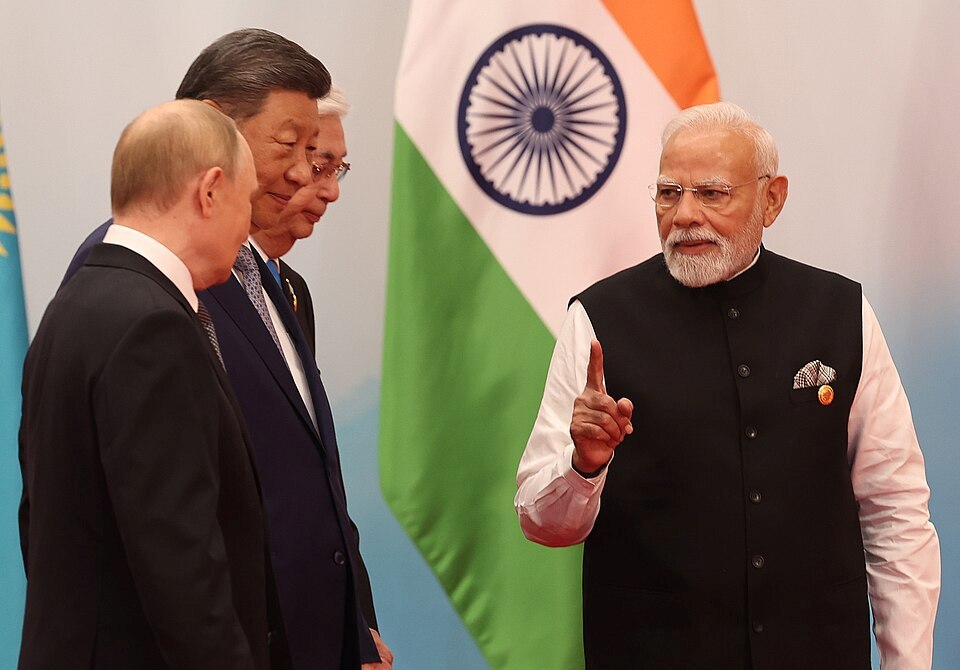
India’s position cannot be understood solely through its attitude toward Russia. For New Delhi, the central principle is what is known as strategic autonomy. India does not want to become part of any global bloc and seeks to maintain working relations simultaneously with the United States, Russia, and China. Russia remains an important partner for India, above all in the military sphere. India needs the United States as an economic and geopolitical partner in its strategic competition with China. And China, despite conflicts and rivalry, remains one of India’s key trading partners. For New Delhi, therefore, choosing one side would mean losing the ability to maneuver between the centers of power.
This is precisely why India has abstained from UN votes concerning Ukraine, declined to join Western sanctions against Russia, and continued purchasing Russian energy resources. Such a policy may appear to constitute support for Russia, but within India’s own framework, it is primarily a matter of protecting its national interests. The argument concerning Russian oil is particularly telling. Indian experts respond to Western criticism with a simple argument: if India does not buy Russian oil, someone else will – above all, China. New Delhi therefore sees little reason to sacrifice its own economic interests for the sake of other countries’ sanctions policies.
This is a pragmatic argument, but for Ukraine it has a very real consequence: the Russian economy continues to receive revenues that enable Moscow to finance the war.
“Ceasefire – Sit Down at the Table – Reach an Agreement”
Another problem arises in views on how the war should end. Indian analysts predominantly call for a diplomatic settlement. At first glance, this is a position that is difficult to dispute: a war should end in peace. But the question is what kind of peace that should be.
Many Indian publications propose roughly the following sequence: first a ceasefire, then negotiations, followed by a peace agreement. At the same time, responsibility for the continuation of hostilities is often assigned to both sides, and sometimes primarily to Ukraine, which is supposedly relying on a military solution instead of diplomacy.
For Ukraine, this presents a fundamental problem. A ceasefire in itself does not mean the end of the war. If the parties have incompatible views on security, territory, and Ukraine’s future, freezing the front line may become merely a pause before another war. That is why the Ukrainian side cannot view peace simply as an end to the shooting. The issue is to establish conditions that will prevent Russia from using the pause to rebuild its military capabilities and repeat its aggression.
Ukraine Resists and Gains Agency
In geopolitical texts by Indian analysts, Ukraine often appears as a weak state caught between Russia and the West. But when they write about military technologies, the picture changes dramatically. Here, Ukraine is no longer a “buffer zone.”
It emerges as a state that has managed to resist a significantly stronger adversary, accumulated unique combat experience, and become one of the leaders in the development of unmanned technologies. Since 2024, assessments of Ukraine have increasingly portrayed it as a state possessing not only military experience but also its own technological capabilities and seeking to play a more active role in international security.
This is an important contradiction in the Indian view of the war: Ukraine may be denied geopolitical agency while its military capabilities are simultaneously recognized. In other words, Ukraine is readily seen as a formidable warrior, a producer of drones, and a source of military technologies, but it is much more skeptical to recognize it as a state that determines for itself whom it wants to align with, which security system it chooses, and what its future should be.
Read also on PostPravda.Info: Followers of Hare Krishna go to fight for Ukraine. War has changed Krishnaites
Why India Finds It Difficult to Understand Russian Imperialism
Indians perceive the Russian-Ukrainian war through the prism of their own historical experience. As a result, the views of Indian analysts largely reflect attitudes and perceptions of Russia that are widespread in Indian society. India itself is a union of different peoples and cultures based on a shared civilizational identity, which is to a considerable extent contrasted with Western civilization. This helps explain why a significant proportion of Indian experts, like Indian society as a whole, tend to view the Russian-Ukrainian war through the logic of “spheres of influence.” Within this logic, however, the interests of major powers become more important than the right of smaller countries to determine their own future.
In seeking to understand Russia through the lens of their own experience, Indian analysts do not always take into account a fundamental difference between the two countries. In its civilizational confrontation with the West, India has consistently opted for peaceful coexistence. Russia, however, has consistently made expansion – including military expansion – its primary strategy. Whereas in India the decision to launch a war and subsequently escalate it cannot depend on the will of a single individual, in Russia’s authoritarian system, by contrast, strategic decisions are made by one person alone – Vladimir Putin – largely on the basis of subjective perceptions and an inadequate understanding of geopolitical reality.
Indian society has a painful memory of a number of Indo-Pakistani wars. However, these conflicts were predominantly regional in nature and were connected to specific territorial and political disputes. Consequently, when projecting their own experience onto the Russian-Ukrainian war, Indian analysts may perceive it as yet another local conflict over disputed territories. Russia’s war, however, is existential in nature and is aimed not only at changing borders but also at destroying Ukrainian identity. For the sake of this irrational objective, the Russian leadership is prepared to pay any price, even if doing so ultimately destroys Russia itself.
Thus, two problems arise that reinforce one another. The first is the unjustified denial of the agency of small and medium-sized states within the logic of “spheres of influence.” The second is a failure to understand the nature of Russian imperialism. This is where the central contradiction in India’s policy emerges. While proclaiming its commitment to peaceful coexistence, respect for sovereignty, and opposition to military expansion, India’s policy of neutrality simultaneously and inadvertently creates space for a tolerant attitude toward Russian imperialism. At the same time, this contradiction may remain invisible to Indian society because it arises at the dividing line between two different historical experiences.
This article was published as part of research conducted within the framework of the research topic of the A. Krymskyi Institute of Oriental Studies of the National Academy of Sciences of Ukraine, “Narratives about Russia’s War in Ukraine in Asian Countries.”
Read also on PostPravda.Info: Andrij Veselowski: India, China, Russia and Ukraine. “Are there reasons for the war to continue” [COLUMN]